The annual overview tasting hosted by wine importer POOT from De Lier is an excellent opportunity to highlight exceptional wineries. This year, the prestigious Cos d’Estournel winery presented a series of wines. The 2019, 2020, and 2021 vintages were presented, as was their 2021 Pagodes de Cos rouge. We often overlook the fact that these classic ‘red’ chateaux also make beautiful whites, but fortunately, we were able to thoroughly sample the 2023 Pagodes de Cos Blanc, which was very impressive. Also the 2024 vintage is already receiving a standing ovation.
Cos d’Estournel – How the past vision created the future.
Some estates are built on tradition; Cos d’Estournel was built on vision — and on the restless curiosity of one extraordinary man. In the early 19th century , Louis Gaspard -Lacoste de Maniban, and Marquis of d’Estournel stood on the rugged rise of Saint‑Estèphe and sensed something others simply didn’t see. Where neighbours saw stubborn gravel and windswept slopes, he saw the majestic pagodes what he inherited in 1791 and recognised the character, nuance, and possibilities of this land. In 1810 he officially gave the property his name.
The estate occupies one of the most privileged sites in the appellation: the gravelly hill of Cos, a deep, complex mosaic of gravel, clay, and limestone that overlooks the Gironde estuary. This unique geological formation—one of the highest points in Saint‑Estèphe—is where COS found his name. In the old Gascon dialect it means ‘hill of pebbles”. It creates exceptional drainage and moderates temperatures, enabling Cabernet Sauvignon and Merlot to reach remarkable levels of ripeness and structure. Over decades, Louis‑Gaspard shaped the property into a model of precision and innovation, establishing the foundations of a terroir renowned today for its power, finesse, and longevity.
In 1791 he began with 14 hectares, but his ambition was never meant to stay small. He bought the surrounding plots one by one, driven by an instinct that each parcel held its own voice. He was among the first to understand the differences between these plots, vinifying each separately in different vessels — a revolutionary approach for his time. By 1851, his estate had grown into a 45‑hectare mosaic of terroirs, each treated with the precision of a winemaker far ahead of his era.

His curiosity stretched far beyond Bordeaux. He experimented with grape varieties from Spain and Italy — historically unrecorded, but unmistakably bold choices that revealed his unconventional mind. And through his ties with the British and the West India Company, he travelled to India four times. Those journeys changed him. They opened his imagination, broadened his aesthetic, and ultimately shaped the soul of Cos d’Estournel.
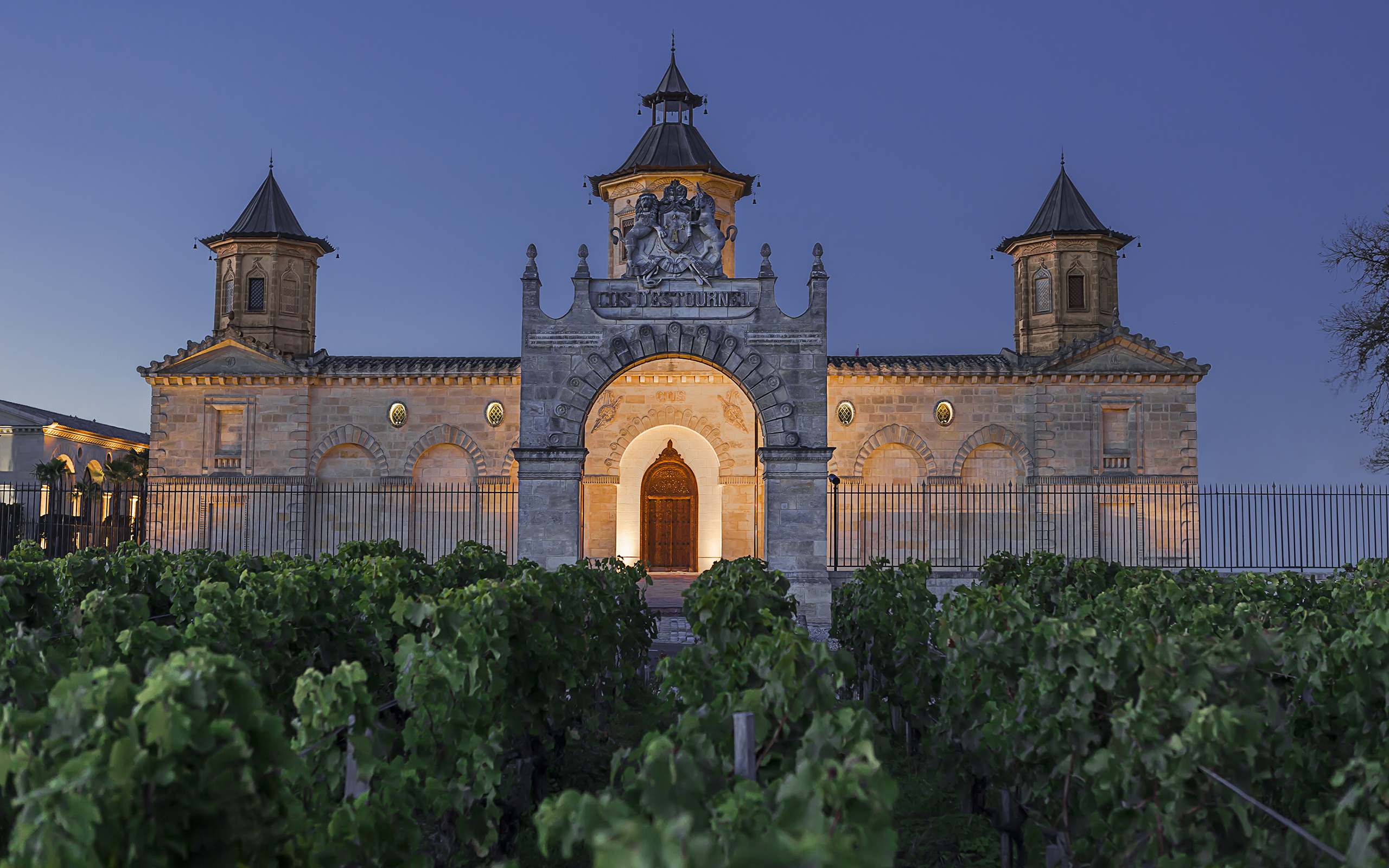
Throughout the early 19th century, he travelled extensively across Asia, the Middle East, and Europe, introducing his wines to new markets and cultivating an international reputation long before global branding existed. Inspired by India, the Orient, and even Zanzibar, he built his château not as a residence, but as a wine‑palace — a place where architecture became storytelling. Warm local limestone, carved wooden doors reminiscent of the Sultan of Zanzibar, and sculpted elephants guarding the entrance all came together in a striking blend of Indian, Islamic, and classical influences. It was unlike anything the Médoc had ever seen.
The British affectionately called him the Maharajah of Saint-Estephe, a nickname he carried with pride. And true to his independent spirit, he refused to sell his wines through the traditional Bordeaux marketplace. He wanted personal connection, personal responsibility, personal pride. Every bottle left the estate bearing the unmistakable label: “Expédié par moi.” Sent by me.
A New Chapter — Michel Reybier

In 2000, a new guardian stepped into this remarkable story. Michel Reybier, a man with a deep belief in the singular identity of Cos d’Estournel, became the estate’s owner. His conviction was clear and unwavering: “It is Cos or nothing.” A bold statement — but one he has lived up to.
After selling his successful agro‑food company Aoste at the end of the 1990s, he dedicated himself fully to the estate. In the spirit of Louis Gaspard d’Estournel, he embraced innovation with respect for heritage.
Cos d’Estournel, classified as a Second Growth in the 1855 Classification has a organic certification. (Don’t try to find it on the bottle because they don’t mention it on the label) The chateau is now in the hands of Michel Reybier. His stewardship has been defined by a commitment to technical excellence and respect for the estate’s heritage. In 2008, he introduced a groundbreaking gravity‑flow winery—the first of its kind in Bordeaux—designed to eliminate pumping and preserve the integrity of the fruit. This state‑of‑the‑art facility allows for gentle handling during vinification, enhancing purity, aromatic definition, and tannin refinement. Also the use of special shaped barrique’s, what ‘breaks’ the hat (the solid cap of grape skins seeds and pulp) to extract color and flavor and soften the tannin, makes the wineproduction in the cellar unique.

The vineyard, planted predominantly to Cabernet Sauvignon with Merlot, Cabernet Franc, and Petit Verdot, is managed parcel by parcel to reflect the diversity of the soils. Each plot is harvested at optimal maturity and vinified separately, enabling precise blending that captures the estate’s signature style: dense, structured wines with remarkable depth, exotic aromatics, and an unmistakable sense of place.
Today, the Grand Vin, Cos d’Estournel, continues to embody the estate’s pursuit of excellence—powerful yet elegant, capable of decades of ageing. Pagodes de Cos, the second label, expresses the same philosophy with a more approachable profile, offering earlier accessibility while retaining the character and complexity of the terroir.
Through centuries of innovation and an unwavering respect for its land, Cos d’Estournel remains one of the most distinctive and forward‑thinking estates in Bordeaux, where heritage and modernity coexist in perfect harmony.
Today, wine lovers and travellers from around the world are captivated by the château’s unique architecture. Thousands of photographs are taken every year; countless memories are made beneath the pagodas and carved elephants. The estate continues to inspire, just as it did in the days of the Maharajah of Saint-Estephe.
Once, there was a man with an extraordinary vision who created this present. Now, the future rests in the hands of Michel Reybier — and there is no doubt that he, too, will leave a legacy. A century from now, people will speak of him with the same admiration and passion. Of that, I am certain.